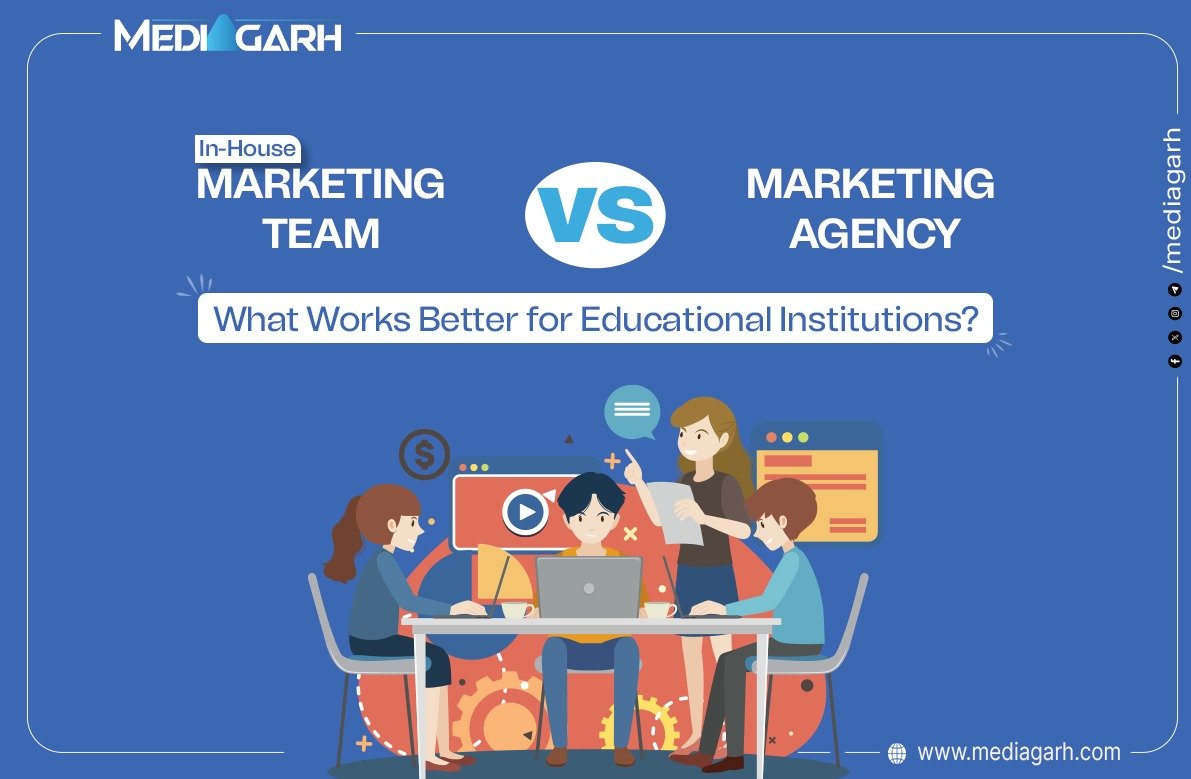
Every college, university, and ed-tech brand faces the same crossroads at some point — do you build your own marketing muscle in-house, or do you hand the reins to a specialized marketing agency for colleges? The answer is rarely black and white, but the right choice can mean the difference between a full classroom and an empty one.
Over the past decade, there has been an important shift in the education industry. Marketing is becoming a strategic necessity rather than a “nice-to-have” due to growing competition among schools, changing student demographics, and the proliferation of online learning. Your marketing strategy has a direct impact on outcomes, regardless of whether you’re a huge university growing its digital presence or a tiny private college looking to increase enrollments.
In this blog, we break down the pros and cons of both models to help educational institutions make an informed decision, one that aligns with their budget, goals, and growth vision.
Understanding the Two Models
The In-House Marketing Team
An in-house team consists of dedicated marketing professionals employed directly by the institution. They understand the campus culture, the academic calendar, internal stakeholders, and the nuances that make your institution unique. They’re in the building figuratively and literally.
The Marketing Agency for Colleges
A marketing agency for colleges is an external firm specializing in education sector campaigns. These agencies bring multidisciplinary expertise: SEO, paid ads, content, social media, and branding and often have a proven track record of driving student enrollments and brand visibility for institutions like yours.
In-House Team: The Case For and Against
Advantages of Keeping Marketing In-House
The greatest advantage an in-house team has is deep institutional knowledge. They can instantly change messaging without long briefing cycles, attend faculty meetings, and comprehend the campus narrative. Having someone inside the walls is important for sensitive communications, such as accreditation announcements or crisis PR.
Another strength is brand consistency. Tone, voice, and visual identity are more strictly managed across all touchpoints, including event banners, email campaigns, and website copy, when your marketing team is an integral part of your company.
Additionally, for institutions focused on building long-term digital marketing careers within their own organization, hiring in-house means nurturing talent that grows with the brand. A young digital marketer who starts in your communications department today could become your CMO in a decade.
Disadvantages of an In-House Setup
The limitations, however, are real. Building a full-stack marketing team covering SEO, PPC, social media, design, video, content, analytics, and email is expensive. Salaries, software tools, training, and benefits add up quickly, often making it prohibitive for smaller or mid-sized institutions.
In-house teams can also suffer from echo chamber thinking. Without exposure to diverse industries and campaigns, creativity can plateau. They may lack specialist knowledge in emerging areas like programmatic advertising, AI-driven personalization, or advanced CRM marketing, skills that a seasoned marketing agency for colleges would already have on hand.
Marketing Agency for Colleges: The Case For and Against
Why Agencies Win for Educational Institutions
The number one reason educational institutions partner with a marketing agency for colleges is access to specialized talent without the overhead. You get an entire team of strategists, creatives, analysts, and media buyers working on your campaigns at a fraction of the cost of hiring each role individually.
Agencies that specialize in education marketing understand the enrollment funnel deeply. They know when to target students during application season, how to run geo-targeted campaigns for open days, and how to craft messaging that resonates with both students and their parents, two very different audiences that must often be spoken to simultaneously.
Scalability is another major advantage. Need to ramp up campaigns during admissions season? Scale back in summer? An agency flexes with your needs. You’re not paying for a full team of 10 people to sit idle between campaigns.
Agencies also bring fresh, data-driven perspectives. Working across multiple clients and industries means they spot trends early and they bring those insights to your campaigns before your competitors catch on.
Potential Downsides of Agency Partnerships
No model is perfect. Agencies require onboarding time to truly understand your institution’s voice and audience. Communication can sometimes feel transactional, and turnaround for quick, informal requests may be slower than with an in-house contact.
There’s also the question of institutional fit. A generalist agency may not deliver the same quality as one that specializes in education. Always vet for relevant sector experience ask for case studies, enrollment impact data, and references from comparable institutions before signing a contract.
Head-to-Head Comparison
| Factor | In-House Team | Marketing Agency for Colleges |
| Cost | Higher fixed costs (salaries, tools, training) | Flexible retainer or project-based pricing |
| Expertise | Generalist with deep brand knowledge | Multi-specialist team, sector-specific experience |
| Speed | Faster for internal, ad-hoc requests | Structured timelines with defined deliverables |
| Brand Consistency | High — team is immersed in the culture | Dependent on brief quality and ongoing alignment |
| Scalability | Limited by headcount and budget | Highly scalable based on campaign needs |
| Digital Marketing Careers | Builds internal talent pipeline | Limited direct career growth within institution |
What Do the Numbers Say?
According to numerous studies conducted in the field of education, schools that collaborate with specialist organizations demonstrate significant gains in cost-per-enrollment and lead quality. Content, email, social media, search, and digital channels now make up the majority of student discovery experiences. Organizations that don’t make the most of these channels run the danger of being outwitted by rivals who do.
The need for internal digital marketing careers in the educational sector is also increasing. Colleges and universities are increasingly employing people for specialized digital positions, such as SEO specialists and content managers, after realizing that brand management requires a certain amount of internal expertise.
The Hybrid Model: Best of Both Worlds
Here’s what many forward-thinking institutions are actually doing: a hybrid approach. They maintain a lean in-house team for brand management, content oversight, and internal communications, while partnering with a marketing agency for colleges for performance marketing, paid media, SEO, and large-scale campaign execution.
This model gives you institutional knowledge plus external expertise. It also prepares your staff for evolving digital marketing careers by exposing them to agency methodologies and best practices. Think of the agency as a force multiplier for a small but capable in-house team.
The key to making hybrid work is clear role definition. Overlap and confusion lead to wasted budget. Set boundaries upfront: who owns the brand guidelines, who approves campaign creative, who handles reporting, and how success is measured.
How to Decide What’s Right for Your Institution
Ask yourself these questions before committing to either model. What is your annual marketing budget, and what portion can realistically go to personnel vs. campaigns? Do you have immediate, specialized needs like a website overhaul, enrollment campaign, or reputation management? Are you building a long-term marketing function that should exist internally, or do you need results now?
Smaller institutions with limited budgets and urgent enrollment targets often benefit most from a specialist marketing agency for colleges, at least in the early stages. Larger universities with established brand teams may find more value in supplementing in-house capability with targeted agency support for specific channels.
Either way, digital marketing careers and capabilities must be treated as a strategic investment, not an afterthought. The institutions that win the enrollment game are the ones that treat marketing with the same rigor they apply to academics.
Conclusion
There is no universal winner between in-house teams and a marketing agency for colleges, the right choice depends on your goals, budget, and timeline. What is clear is that a passive or underfunded marketing function is no longer an option in today’s competitive education landscape.
If you’re scaling fast and need measurable enrollment impact quickly, a specialized agency is your strongest bet. If you’re investing in long-term institutional brand equity and digital marketing careers within your organization, building in-house makes sense. And if you can swing it, the hybrid model gives you the strategic edge that most institutions are only just beginning to discover.
The smartest educational institutions aren’t asking “agency or in-house?”; they’re asking, “How do we build the most effective marketing engine for our students, our mission, and our future?”