A parent in Dehradun asks an AI assistant which CBSE school near her has strong academics and reliable transport. A Class 12 student asks which BBA colleges in his state have honest placement records. Neither will see a page of ten blue links first. They will see an answer, with a handful of sources behind it.
If your institution isn’t among those sources, or if the answer contains the wrong fee or an outdated admission date, you may be out of the shortlist before your website is ever opened.
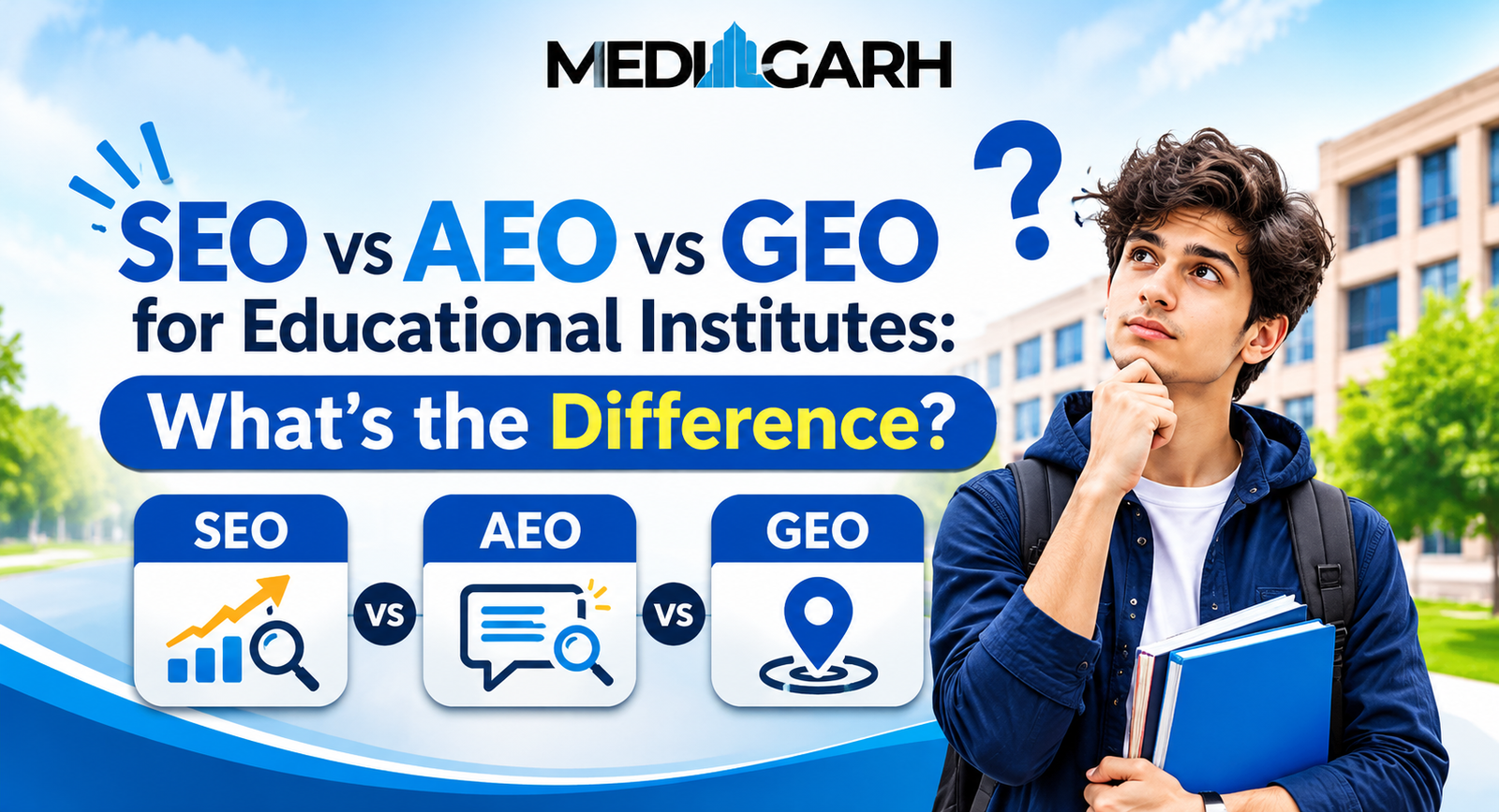
That is why three acronyms are suddenly everywhere: SEO, AEO and GEO. Agencies label them as the top SEO services for schools & educational institutes, vendors sell tools for each, and Google itself says the whole debate is simpler than it looks. This guide explains the difference in plain English and shows what schools and colleges should actually do.
At a Glance
A useful way to remember it, borrowed from how Neil Patel described it in his comparison of GEO vs SEO: “SEO gets you discovered. GEO gets you included in the answer.” In his separate GEO vs AEO post, he describes AEO as the practice of showing up as the answer to a short, direct question, while GEO is about becoming a source that AI tools summarise and cite.
| SEO | AEO | GEO | |
| Main goal | Be found and ranked | Be the direct answer | Be cited in AI responses |
| Where it shows up | Search results, maps | Featured snippets, “People also ask,” voice, AI answers | AI Overviews, AI Mode, ChatGPT, Gemini, Perplexity |
| What helps most | Technical health, useful pages, authority, local profile | Clear questions and short, accurate answers on the page | Accurate, consistent, credible information across the web |
| How it’s measured | Rankings, clicks, inquiries | Snippet and answer appearances | Mentions, citations, AI visibility reports |
| Example of AI Search for Education Industry | Ranking for “BBA colleges in Jaipur” | A clear answer to “What is the fee for B.Tech at [institution]?” | An AI assistant naming your school when a parent asks about the best option near them |
What Is SEO for an Educational Institution?
SEO is the foundation of online visibility for educational institutions. It covers:
- Technical health: pages that load fast on phones, can be crawled and indexed, and aren’t duplicated.
- Useful content: clear programme, admission and fee pages that answer real questions.
- Local presence: an accurate Google Business Profile, genuine reviews and consistent contact details.
- Authority: mentions, links and a reputation that tell search engines (and families) you can be trusted.
For schools, SEO is often local (“CBSE school near me”). For colleges, it is programme-led (“MBA in finance, [city]”). We cover each step in detail in our SEO for educational institutions guide.
What SEO still does best: it brings in people who are actively searching, and it builds the website, reputation and brand search that every AI tool also relies on.
What Is AEO (Answer Engine Optimisation)?
AEO has two meanings in circulation, which is part of why it confuses people:
- The older meaning: optimising to appear as a direct answer such as a featured snippet, a “People also ask” box or a voice assistant response.
- The newer meaning: optimising for AI answer tools that give a direct response to a question.
Both share one idea: people want the answer, not a list of links.
AEO for Educational Institutions
Families ask short, practical questions:
- “What is the fee for [program] at [institution]?”
- “What is the eligibility for [program]?”
- “What is the last date for admission to Class 1?”
- “Is [institution] UGC or AICTE approved?”
- “Is there a scholarship for [program]?”
An answer-ready page gives a clear, direct reply near the top (two to four sentences), then adds detail below. Question-style headings, short paragraphs, lists and tables all help.
What Is GEO (Generative Engine Optimisation)?
Generative engines such as Google AI Overviews, ChatGPT, Gemini and Perplexity don’t just list pages. They write an answer, drawing on several sources and often showing citations.
The term GEO comes from an academic paper, “GEO: Generative Engine Optimization”, presented at KDD 2024 by researchers from Princeton, Georgia Tech, the Allen Institute for AI and IIT Delhi. In controlled tests, adding things like citations, quotations and statistics improved how often content surfaced by up to about 40%. That is a research benchmark, not a promise about admissions, but it supports a simple idea: well-sourced, specific, credible content is easier for AI to use.
How AI tools find sources
AI assistants often don’t just search your question. They run several related searches behind the scenes (sometimes called “query fan-out”) and combine what they find. That is why the sources they cite can look different from a normal Google results page.
In practice, GEO for educational institutions means making sure that when an AI tool looks you up, it finds:
- Accurate, consistent facts (fees, programmes, recognition, dates, contact details)
- Credible evidence (outcomes with the method explained, named faculty, real student stories)
- Third-party signals (reviews, news coverage, directory profiles, alumni mentions)
- Fresh, dated information, not last year’s fee circular
SEO vs AEO vs GEO: Where They Overlap and Where They Differ
Most of the work overlaps. Fast pages, clear writing, accurate facts, strong E-E-A-T (experience, expertise, authority and trust) and a good reputation help all three. The differences are mainly in focus and measurement.
| SEO | AEO | GEO | |
| Primary question it answers | “How do we get found?” | “How do we become the answer?” | “How do we get cited by AI?” |
| Typical effort | Ongoing foundation | Page-level writing and structure | Consistency across site, profiles and web |
| Overlap with the others | Foundation for both | High overlap with SEO | High overlap with SEO, plus off-site presence |
| Key risk | Treating it as one-off | Chasing schema tricks | Chasing “AI ranking” hacks |
| Best first step | Fix indexing, speed and programme pages | Add direct answers to key pages | Audit what AI tools say about you |
What Google Says (and Why It Isn’t the Whole Story)
Google’s official position
On 15 May 2026, Google published a guide called “Optimizing your website for generative AI features on Google Search. Its message, as reported by Search Engine Journal, is that for Google Search, optimising for AI features is optimising for the search experience, so it is still SEO. In short, Google says there is no such thing as AI SEO for education.
Google lists things site owners can ignore for its AI features:
- Special llms.txt or other AI-specific files
- Breaking content into small “chunks” for AI
- Rewriting content in a special way for AI
- Seeking inauthentic mentions (for example, planting references to yourself)
- Special schema markup (structured data isn’t required for generative AI search)
What Google says to focus on:
- Unique, non-commodity content, meaning content with real insight, not generic text anyone could write
- Pages that are crawlable, indexed and eligible to show a snippet
- A good page experience and less duplicate content
- Accurate Google Business Profile information for local visibility
- Quality images and video
Google’s reach here is large. It reports that AI Overviews has more than 2.5 billion monthly users and AI Mode has passed one billion.
But other AI tools don’t work like Google
Google is only one engine. An Ahrefs study of 15,000 queries (data from July 2025) found that:
- About 76% of citations in Google AI Overviews came from pages already in Google’s top 10.
- But across ChatGPT, Gemini, Copilot and Perplexity, only around 12% of cited URLs also ranked in Google’s top 10 for the same prompt. Perplexity was the most aligned with Google (about 29%), and ChatGPT was among the least (about 8%).
AI tools change quickly, so treat that as a snapshot, not a rule. But the lesson is helpful: ranking on Google helps a lot for Google’s AI features, while for other assistants, your wider reputation and the consistency of your information across the web matter too. So “AEO and GEO are just SEO” is largely true for Google, and incomplete for the wider AI landscape.
Why This Matters in India
Students are early AI adopters
- OpenAI says India has more than 100 million weekly ChatGPT users (February 2026), with the largest number of student users in the world. OpenAI’s own India report says users aged 18-24 send the largest share of messages and that Indians ask about education and learning at nearly twice the global median. OpenAI India’s head has since said India has become ChatGPT’s largest market by weekly users.
- Google says India has its largest user base for voice and visual search globally, and AI Mode is available in India, with Hindi and other Indian languages added.
Education portals are feeling it
Shiksha, a major education portal run by Info Edge, reported that its billings fell 13% year on year in January-March 2026, 23% in April-June and 27.2% in July-September, which the company linked to AI changing how people search. That is one company’s experience, not proof that every site is losing traffic. But it is a reminder that relying on third-party channels for discovery is risky.
Early signs of strong intent
Education CRM provider Meritto’s 2026 Enrollment Index, built on 4.3 crore inquiry journeys, reports that students who discover institutions through AI platforms are about six times more likely to enrol than those from other digital channels. This is vendor data, and AI discovery is likely still a small share of the total, so read it as a signal of high intent, not proof that AI is the main door.
In the US, an EAB survey (February 2026) found 46% of high-school students had used AI tools in their college search. India-specific data is still emerging, but the direction is clear.
AI Search Optimization for Colleges vs Schools: What Changes?
| Schools | Colleges and universities | |
| Typical AI questions | “Best CBSE school near [locality]?””Which school has safe transport?””Fee for Class 6 at [school]?” | “Best BBA colleges in [state]?””[College] placements?””[College A] vs [College B]?””Is [programme] AICTE approved?” |
| Who is asking | Mostly parents | Students and parents together |
| What to publish and keep accurate | Board, grades, fees, transport, safety, teachers, admission dates, locality served | Programme pages, eligibility, fees, scholarships, outcomes with method, recognition status, admission steps |
| Off-site signals that matter | Google reviews, local mentions, parent testimonials | Directory profiles, alum stories, news, student discussions |
| Biggest quick win | Complete, accurate Google Business Profile and school page | One clear, current page per programme |
Myths and Hype to Skip
“We need an llms.txt file.” Google says special AI files aren’t needed for its AI features. Other tools may treat them differently, but there is no proven benefit to rely on.
“Split your content into small chunks for AI.” Google says its systems can understand multiple topics on a page, so chunking isn’t required. Write for people, with clear headings.
“Schema guarantees AI citations.” Structured data helps systems understand a page, but Google says it isn’t required for AI search, and FAQ and HowTo rich results no longer appear. Use markup where it accurately describes your content, not as a trick.
“Buy mentions and citations.” Google’s spam policies now explicitly cover attempts to manipulate AI responses. Fake reviews, planted forum posts and paid mention schemes are risky.
“GEO replaces SEO.” It doesn’t. AI tools still depend on a web full of well-built, well-regarded pages, and Google’s AI features draw on its search systems.
“SEO is dead.” Rankings alone matter less, but the fundamentals matter more.
“We can guarantee you’ll appear in ChatGPT.” No one controls what an AI tool says. Practitioners debating this on forums such as Reddit are divided between those who see AEO/GEO as relabelled SEO and those who see real new work, but both camps tend to agree that guarantees are a red flag.
Unsourced statistics. Be careful with “X% of searches end without a click” claims that don’t name a study. Check the source before repeating them.
Frequently Asked Questions
Are AEO and GEO different things or the same?
AEO and GEO are two completely different things. AEO focuses on optimizing for direct answers in the search results. On the other hand, GEO is creating content that AI tools can summarize and cite.
Do I need GEO if I already do SEO?
Yes, you do. SEO helps you optimize for traditional search results. With GEO, you adapt to the latest developments in the industry.
Does GEO replace SEO?
No, it doesn’t. GEO builds on SEO. Content still stays the key. It’s just that with GEO you also optimize it for AI tools.
Do we need an llms.txt file or special schema (including FAQ)?
For Google Search, no. Other tools may behave differently, but there’s no proven benefit to rely on. Spend your time on accurate, useful pages instead.
Conclusion
The families you want to reach are already asking AI tools about schools and colleges. The institutions that do best will not be the ones that chase every new acronym. They will be the ones with a fast, accurate website, clear answers, a trustworthy reputation and a habit of checking what the world and AI say about them.
If you’d like help, Mediagarh works exclusively with educational institutions on SEO, AEO and GEO, alongside websites, advertising, lead automation and nurturing. Or download the prompt-audit template and start with your own audit this month.