All admission heads will agree with this: traditional collateral like college brochures has lost its relevance in the current admission cycles. All decision-makers come with their homework already done. They have their research with them through AI assistants, Instagram Reels, GMB reviews, and friends’ opinions. Educational institutes need to understand that a parent filling out a form has already made a decision.
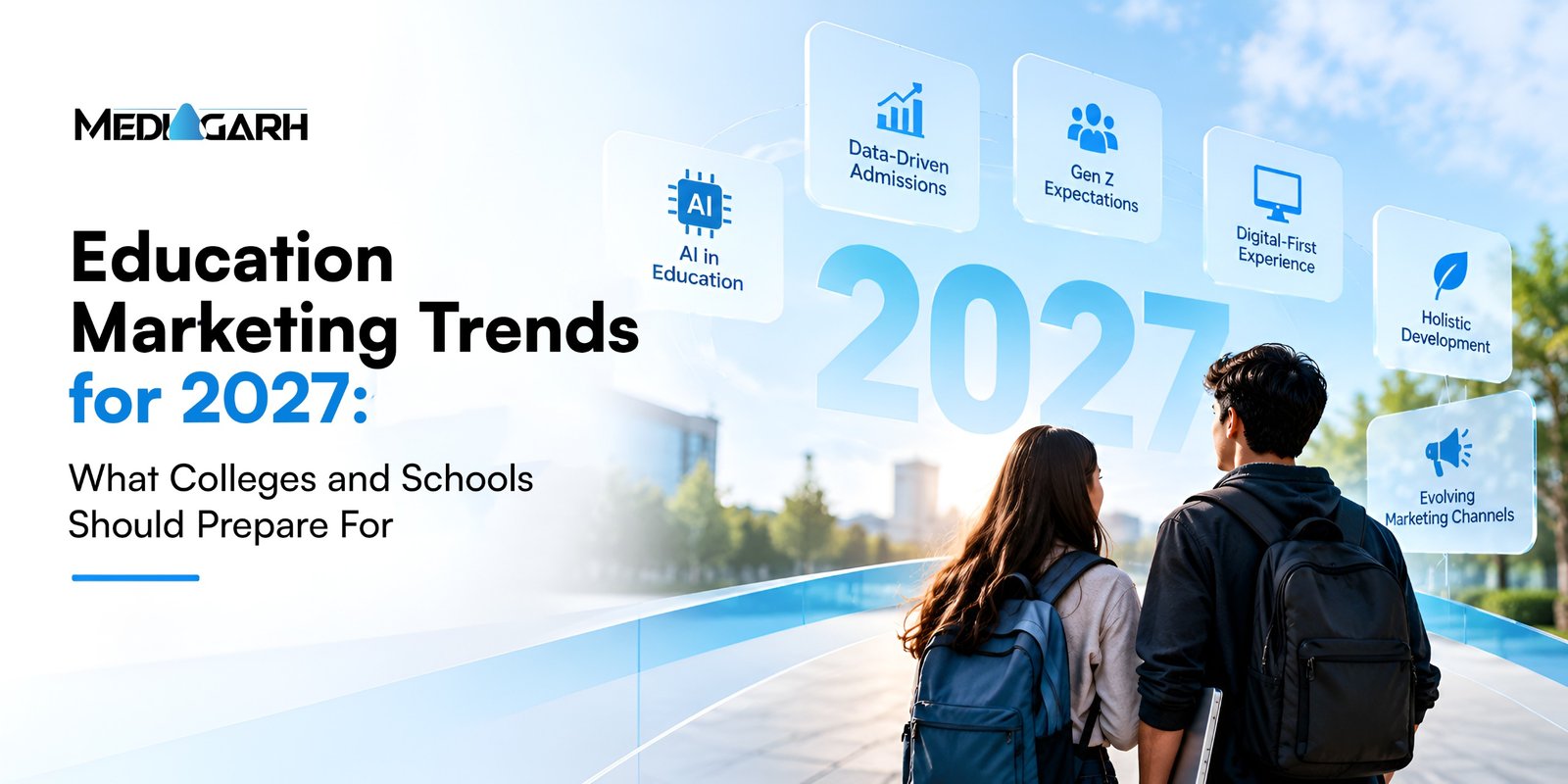
That is the real story behind education marketing in 2027. The tools matter less than a shift in where trust is built, how fast you respond, and how openly you share proof. This is an important insight for education marketing teams to catch up with the latest trends that are shaping audience behaviour. This guide covers eight trends, expected to be amplified in 2027, that will shape the new admission cycle in India.
Trend 1: AI Search Becomes a First Stop for Families
Since last year, all AI chatbot tools like Gemini and ChatGPT have offered free models of their premium versions for large-scale data hoarding from the Indian market. This made AI tools very accessible to the decision makers for school & college admissions. Though we do not have India-specific data on this, some US combined data shows (which is expected to be replicated in the Indian market as well):
- 46% of high-school students used AI tools for college search
- 36% of students start their initial research with AI (over Google)
- 9 in 10 Indian internet users use apps with embedded AI features
However, all of this data doesn’t point to you learning a new marketing secret. Google highlights that even with AI, it relies heavily on information from websites and GMB profiles. If so, the EEAT principles of Experience, Expertise, Authoritativeness, and Trustworthiness have become more important than ever before. Institutions should keep consistent information across their digital presence and try polishing the content for primary pages on their website.
Trend 2: Trust and Verifiable Proof Beat Promises
Education is a considerably huge commitment (both financially and temporally) that students and parents make. The smallest misinformation can lead to distrust among the audience—placement numbers, testimonials, etc. In addition to that, in November 2024, India’s consumer authority issued guidelines against misleading advertising in the coaching sector and fined 18 coaching institutes ₹54.6 lakh. That means there can be legal issues as well.
Just change your strategy a bit. Provide actual details, make it accessible for people to talk to current students, and show the method behind the numbers. Don’t just write “100%” if you won’t be able to justify that.
Trend 3: Speed and Conversation Decide Who Wins the Inquiry
The time taken to get back to an inquiry is inversely proportional to securing admissions. Industry practitioners cite a benchmark of 500,000+ inquiries in which replying within five minutes was associated with roughly 28% higher conversion.
WhatsApp is a highly used conversation channel that is quick, informal, and often shared between parents and the student. Here’s everything you should check:
- Weekly response-time target
- Cover evenings and weekends
- Use automated first responses
- Build a nurture sequence
- If working with an education marketing agency, also check for CRM integrations and log ins
Trend 4: Short-Form, Vernacular, Student-Led Video Becomes the Default
This is a trend every person minutely attached with marketing will agree with. India has shifted towards a short-form discovery habit. 61% of Indian users are watching short-form content, and catching attention has become highly complex. It means your DSLR-shot campus video with 5 transitions does not make the cut for most Indians today.
Build a content pipeline where you bring in students and faculty, and do actual objection handling through videos. Also, optimize this for regional languages because that takes up a big chunk of India.
Trend 5 (Schools): Parent-First Marketing in a Changing Market
As a school, if you already know your target audience is parents: great! But you need to adapt to the more competitive parent market. In today’s market, parents are actually valuing:
- Regular teacher attendance
- Uniforms
- CCTV
- Transport
These might feel like just “normal” offerings. Surprisingly, most schools are unable to match these expectations. However, the trick is simple (the secret sauce of a marketing agency for schools). Prioritize Google reviews, parent testimonials, and community presence that is parent-friendly, and you’re good to go.
Trend 6 (Colleges): Positioning in a More Crowded Field
Colleges are playing on a completely different field than schools. Everyone is fighting for the same “good faculty, great campus, strong placements.” As a college, you need to position yourselves as unique among the competition.
Finalize your top USPs, and compare accordingly. That’s why you will see every marketing agency for colleges competing for foreign campuses, expanding private institutions and online options. It’s clearly brand name vs. outcomes, values, and experiences.
Trend 7: Data Privacy and Compliant Lead Capture (DPDP)
India’s Digital Personal Data Protection (DPDP), which comes into effect from May 2027, obliges educational institutions to obtain verifiable parental consent before using the data of anyone under 18. There are minor exemptions for educational institutions, but that isn’t a carve-out.
You should definitely prepare:
- Audit forms, landing pages, WhatsApp, events, agents
- Move to clear, consent-first forms in plain language
- Capturing & recording (plan) parental consent
- Review how your agencies, CRM and ad platforms store and share data
- Only store important data (time-bound)
Privacy-first steps also generate credibility for your education marketing.
Trend 8: From Cost Per Lead to Cost Per Enrolled Student
Lead volume doesn’t matter if you are unable to enroll a student. Low CPL with many leads isn’t the win. The following metrics show the real win in 2027:
- Cost per enrolled student
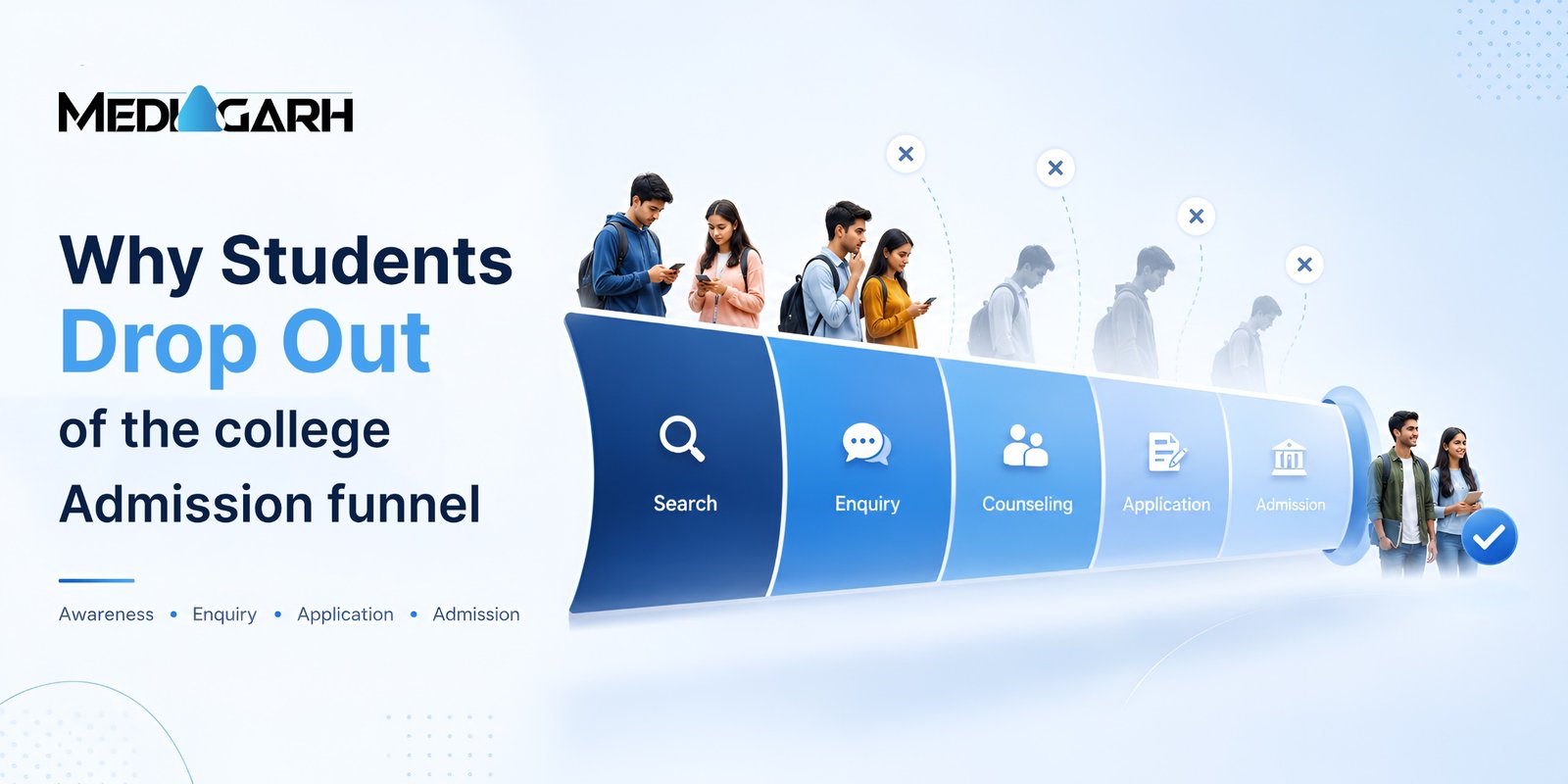
- Inquiry-to-visit and visit-to-admission rates
- Response time to new inquiries
- Lead quality by source, campaign and programme
- Counsellor follow-up rates and drop-off stage
- Brand search growth
Your 2027 Preparation Checklist
| Area | Action | When |
| AI and search visibility | Check how AI tools describe your institution; fix inaccurate or missing information | Now |
| Website | Make programme, fee, eligibility and admission pages clear, current and fast on mobile | Now |
| Proof | Replace vague claims with specific, sourced results and named, consented testimonials | Before the intake campaign |
| Response speed | Set a response-time target; cover evenings and weekends | Now |
| Conversation | Set up WhatsApp-based first response and a nurture sequence with human handover | Before intake |
| Video | Plan a monthly short-form pipeline in regional languages, led by students and teachers | Ongoing |
| Schools only | Highlight teacher quality, safety and parent communication; strengthen local reviews | Before the intake campaign |
| Colleges only | Define your differentiator per programme; create comparison-ready content | Before the intake campaign |
| Privacy | Audit data collection; build consent-first forms; plan parental consent for minors | Before ~May 2027 |
| Measurement | Track cost per enrolled student and funnel conversion in one CRM | Ongoing |
Conclusion
The 2027 admission cycle will reward institutions that make it easy to find accurate information, believe what they read, get a quick human response and feel respected in how their data is handled. This requires an understanding of marketing trends that will prevail in the coming year. The top 10 digital marketing companies for educational institutions, like Mediagarh, are already catching up with these. If you want to adapt fast, get in touch to talk through your 2027 plan.