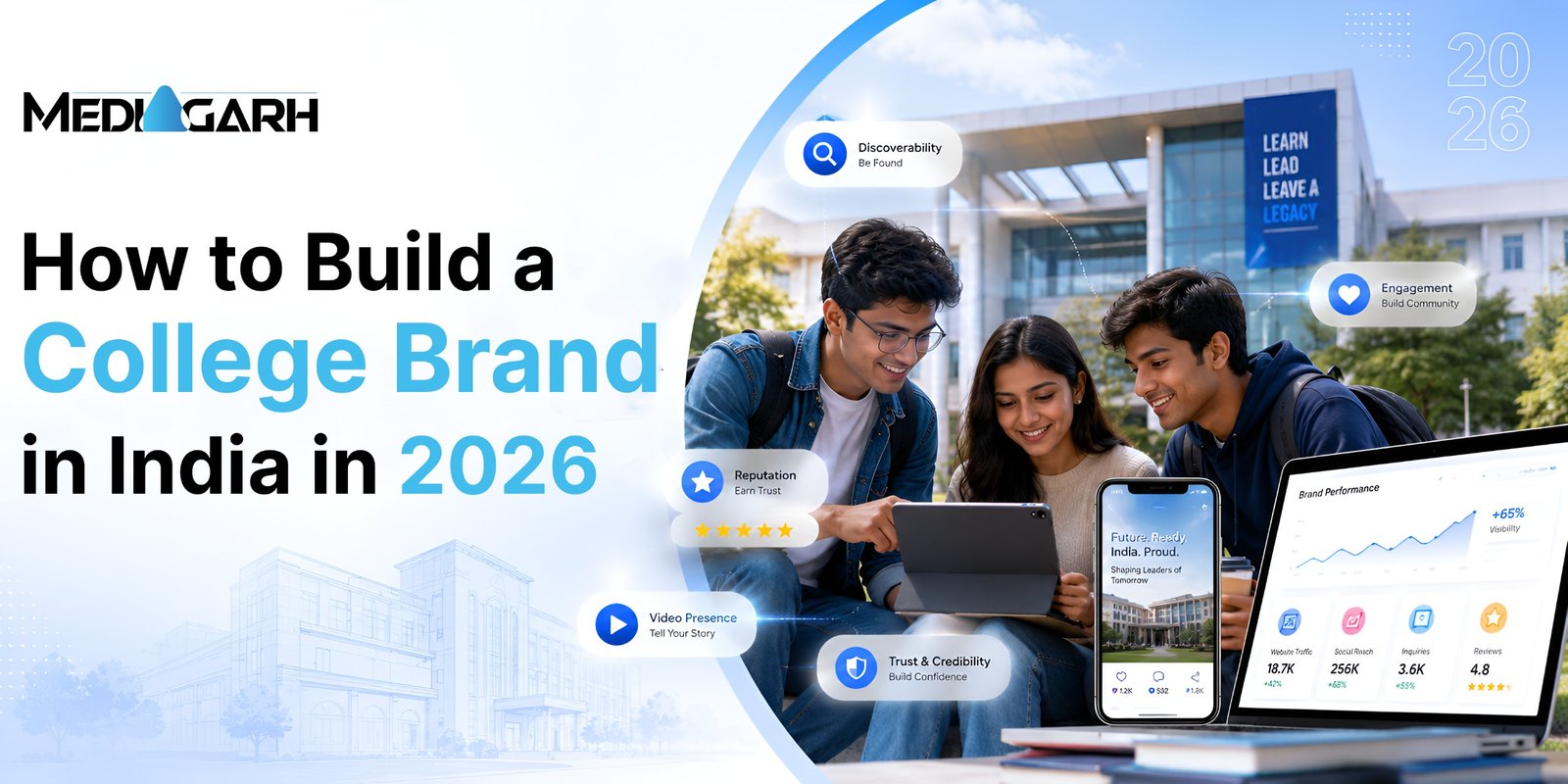
Branding is the biggest marketing factor that most colleges get wrong. Colleges have to understand that every institution stands for something. For example, when you hear about IIT or AIIMS colleges, you intuitively have something pop up in your mind about them. It’s because of their branding—attributed to campus, placements, faculty, student life, a particular course, or an alumnus. It is very important for any college because it brings recall to your institution’s name, helping you achieve all objectives.
But how do you build this? The simple answer: don’t build your brand around what you want to say about your college. Build it around what you want students to believe—and give them enough proof to believe it.
What Does a College Brand Actually Mean?
Two words are relevant here:
- Brand identity – what you create
- Brand perception – what people remember
In the simplest sense, brand identity is what you visually create and put out for the public eye. This includes (but is not limited to) your logo, colours, fonts, tagline and website design.
Brand perception goes beyond basic visual presentations. It is developed by what people make of your content. They might interact with your brand through:
- Academics
- Faculty
- Placements
- Campus experience
- Infrastructure
- Student life
- Industry exposure
- Alumni
- Reviews
- Social media
- Website
- Admission experience
Brand identity can be easy to excel at. Brand perception is what we are targeting in this guide. Let’s understand how you can do that.
- Define What Your College Should Be Known For
Keep your never-ending list of USPs aside for a moment. If you wanted one thing that people should recognize your institute for, what would it be? That’s exactly what will rule your brand perception. It will provide you with a blueprint for the communication hierarchy that will be followed across all marketing channels. It will also require you to ditch the general terminologies and similar phrases, and start using differentiators that your institution can own.
- Build Your Positioning Around a Real Differentiator
Whatever communication phrase you choose, you need to have sufficient evidence to prove the claim. Here’s how this will look for a representative college:
| Positioning Statement A Career-Focused College ↓ What You Offer Industry-integrated learning. ↓ Why It Matters Students gain practical exposure before graduation. ↓ What Proves It Internships Live projects Industry mentors Recruiter relationships Alumni outcomes ↓ How You Communicate It Student stories Faculty videos Internship case studies Placement content Course pages |
- Replace Marketing Claims With Proof
This can be closely related to a major conundrum in marketing that can be referred to as the feature-benefit conundrum. What most colleges do is highlight the features of their college. Students are not there for your claims in the form of features. Instead, they want actual proof that will be of benefit to them. A simple example would be:
“We provide excellent placement opportunities.” 👎
“95% of students from the 2026 batch secured internships and placements across 18 industries, with 200 recruiters and career outcomes.” ✅✅
A content system around this would look like
| Academic Proof | Career Proof | Student-Life Proof | Industry Proof | Infrastructure Proof | Trust Proof |
| Faculty expertise | Placements | Clubs | Partnerships | Labs | Accreditation |
| Research | Internships | Events | Live projects | Libraries | Rankings |
| Curriculum | Recruiters | Campus culture | Guest lectures | Studios | Reviews |
| Student projects | Alumni careers | Student experiences | Industry mentors | Sports facilities | Transparent information |
- Make Student Outcomes Part of Your Brand
This is quite aligned with the phenomenon we listed in the last point. Move from the ‘we’ language to ‘you’ language. Students are not there to hear praises about you. They want to hear how it will help them. The following table lists some factors from both languages.
| ‘We’ Language | ‘You’ Language |
| Beautiful classrooms | Internships |
| Campus buildings | Placements |
| Cultural events | Entrepreneurship |
| Smart classrooms | Research |
| Higher studies | |
| Competitions | |
| Certifications | |
| Industry projects | |
| Alumni achievements |
- Turn Students Into Brand Ambassadors
There’s a reason why user-generated content (UGC) works. And it could work for your college too. Students trust students. Instead of you saying that ‘the college offers a vibrant experience,’ let a student show it through:
- Day-in-the-life videos
- Campus tours
- Club videos
- Event content
- Hostel experiences
- Faculty Q&As
- Student testimonials
- “Things I wish I knew” videos
Any modern higher education branding agency will primarily use UGC for overall branding effectiveness.
- Build a Consistent Brand Voice
Consistency helps your college generate brand recall. What we are essentially talking about is bringing harmony in the brand voice across all channels. Choose one:
- Academic
- Ambitious
- Approachable
- Career-focused
- Youthful
- Research-oriented
- Community-driven
Now, register it as your brand voice, and apply it across:
- Website
- Social media
- Advertisements
- Emails
- Brochures
- Admission communication
- Events
- Videos
This even applies to communication mediums like your admissions counsellors, because the goal is to create a completely consistent presence.
- Make Your Website the Trust and Verification Layer
Your website should feel trustworthy. It is the largest directory of facts across all your marketing channels. Make it absolutely easy for students to find information about:
- Courses
- Eligibility
- Fees
- Faculty
- Placements
- Accreditation
- Scholarships
- Campus information
- Admission process
- Student outcomes
Make the information easy to find, easy to understand and easy to verify.
- Build a “Search-Everywhere” Brand
A student should be easily able to find your brand in all relevant places they could search for. It means you don’t just have to rank well on Google, but also on:
- YouTube
- Education portals
- Review platforms
- Alum content
- News websites
- AI search
This omnipresence is what you call brand presence.
- Prepare Your College for AI-Assisted Search
We have rapidly moved into an AI search era. Today, students use AI tools as their primary source to seek information. AI uses the web as its source for all information. As a college trying to build a brand in 2026, your focus should be to keep the digital information system clean. It doesn’t mean you should try to manipulate AI. Just put out all the factual & current information about everything that a student might be looking for.
- Make Reputation Management Part of Branding
Reputation management is about managing what people say about you, generally on:
- Google reviews
- Student comments
- Reddit discussions
- YouTube videos
- Alum posts
- Education portal reviews
Most colleges have got reputation management wrong. It isn’t about getting the bad remarks removed. It is rationally handling them through the following approach:
Listen → Verify → Respond → Improve → Communicate
Also, look for patterns and turn them into improvements and content for your marketing channels.
- Turn Faculty Into Brand Assets
Faculty are often one of the most underused assets in college marketing. But they are among the most sought-after information by students. That’s why your faculty can move beyond only their photos on the website. Turn their expertise into content like:
- Professor explains: Is an MBA still worth pursuing in 2026?
- Faculty Q&A: What skills should BCA students develop before graduation?
- The professor explains the latest development in AI and what it means for students.
You can use such content across all social media, specialized channels, websites, etc.
- Turn Alumni Into Long-Term Brand Assets
The easiest way to understand is that we are eventually making the alumni your brand testimonials. It’s just that you can put a twist on the content that you publish with them:
- From BCA student to software professional
- From MBA graduate to entrepreneur
- How a student secured their first internship
- Where the 2018 graduating batch is today
- How an alumnus transitioned into a new career
Show realistic journeys that prospective students can identify with, instead of only celebrity alums.
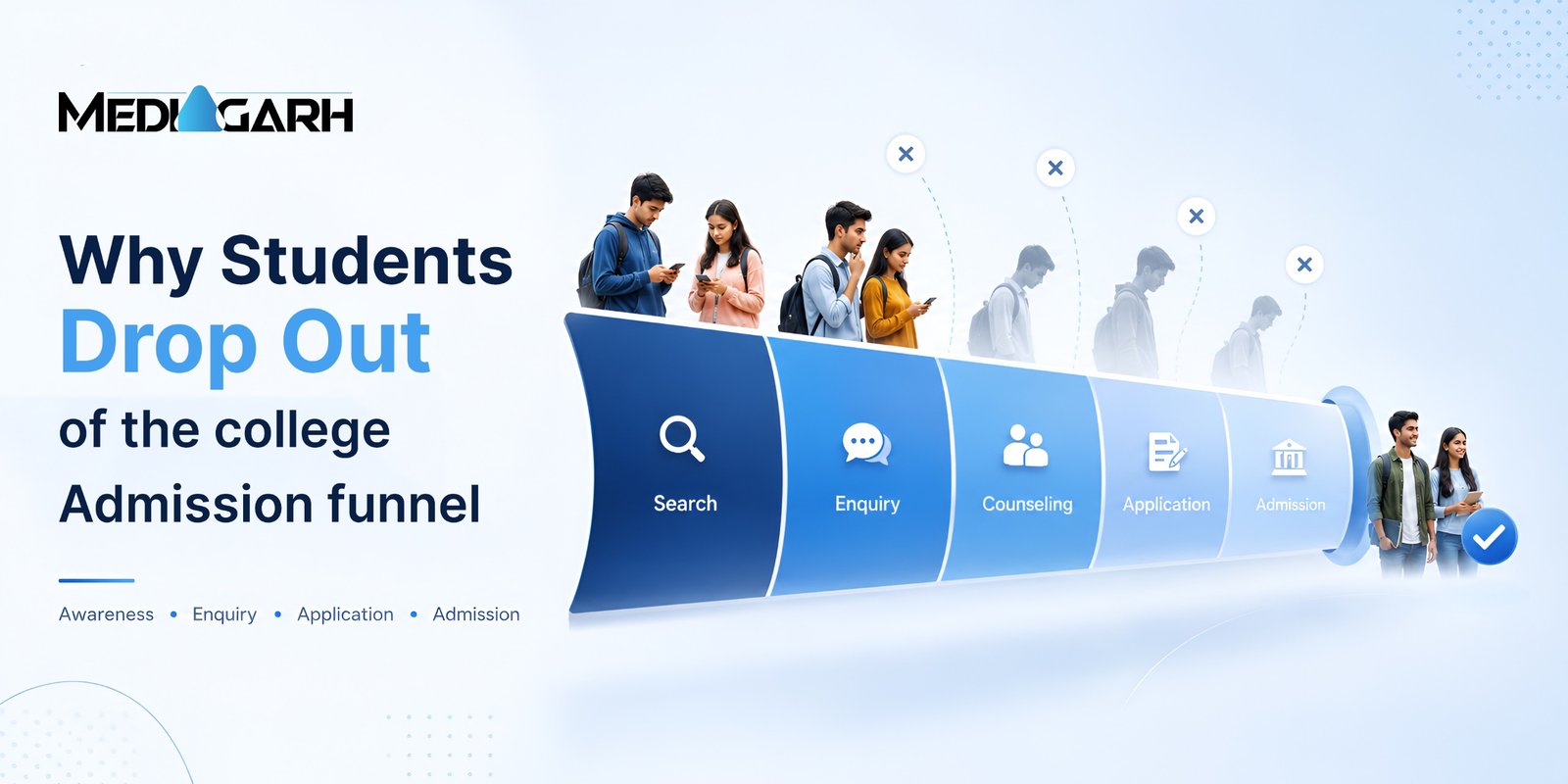
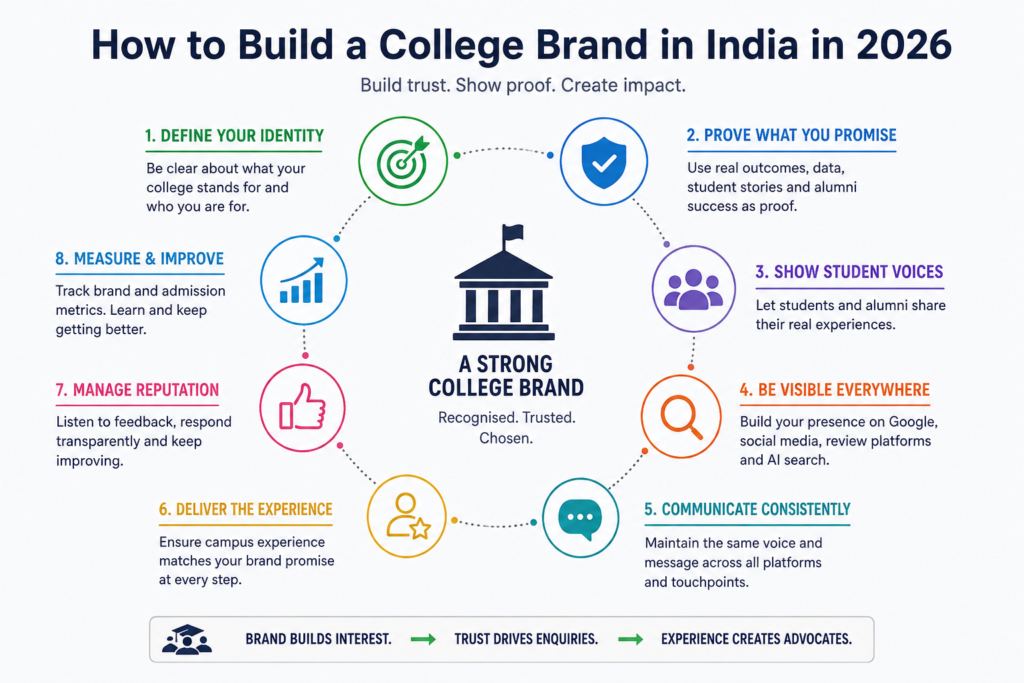
The New Branding-Admission Funnel
We are definitely not telling you to ignore the admissions part. The new college admission funnel where branding and admissions work in tandem should look something like this.
Final Thoughts
Here is what a strong college brand looks like in 2026:
- Clearly Positioned
- Supported by Proof
- Humanised by Students & Alumni
- Visible Across Search & Social Platforms
- Easy to Verify
- Consistent With the Actual Student Experience
Building this is not a heavy task if you take minute intricacies into account, as this guide mentions. If you are considering hiring the best college marketing agency in India for your institution’s branding, you should use this guide as the blueprint for the exact knowledge you should be looking for.