Hear this scenario out:
You ran admission ad campaigns, and they generated 1000 admission enquiries. The marketing team seems happy. But when you come down to the admissions number, it feels a bit off. Only 50 admissions.
Does this scenario seem relatable to any extent? Then there’s learning coming your way. The discrepancy that shows in the final admission numbers is due to potential leakages in the admissions funnel. These are rarely fixed by increasing the ad budget. You need to ask yourself a very important question: Where are students dropping out of your existing admission funnel?
What Does It Mean When a Student Drops Out of the Admission Funnel?
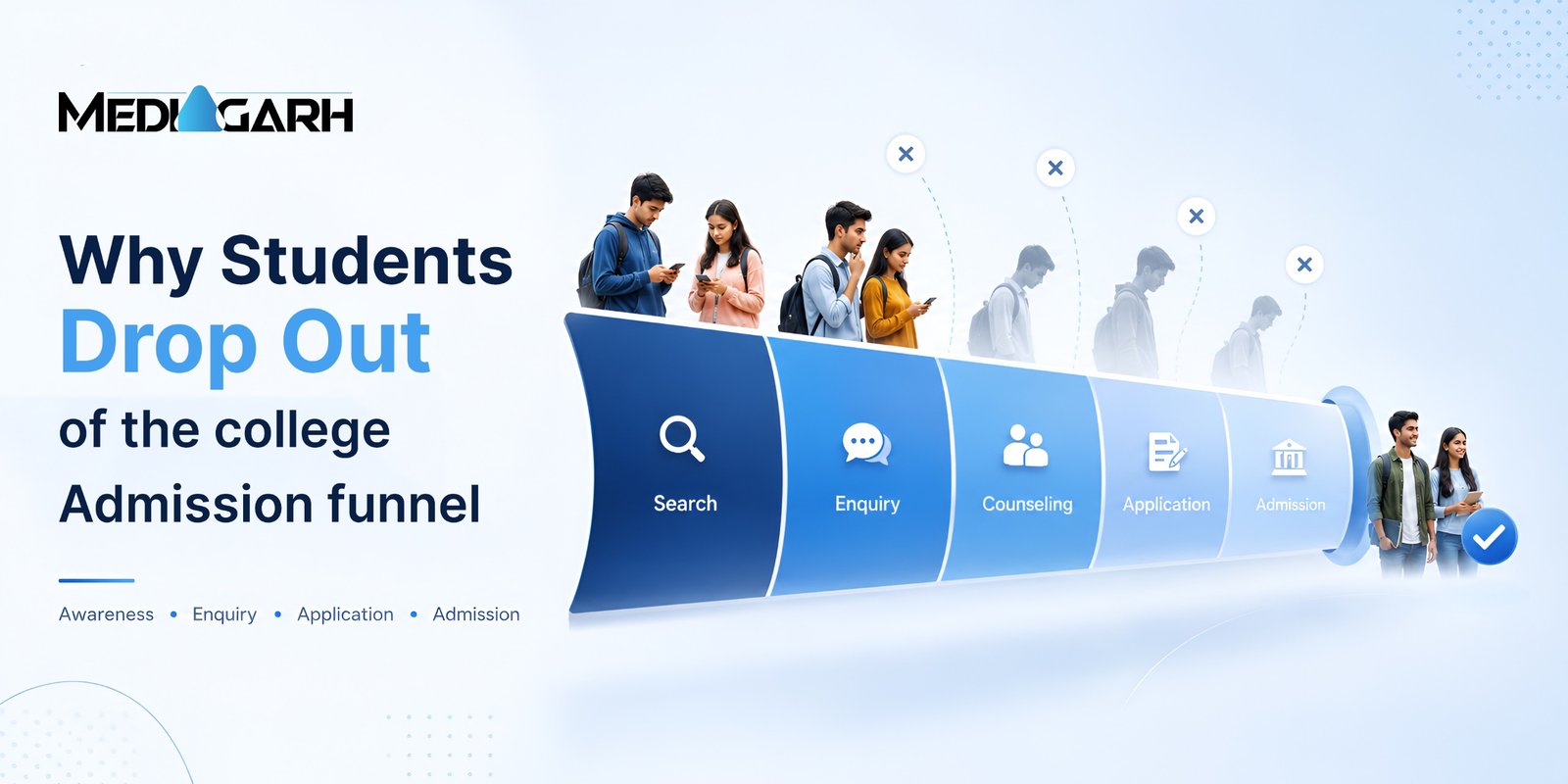
Here is a brief visual of a college admissions funnel:
Lead Generated → First Contact → Counselling → Nurturing → Application → Campus Visit → Admission
Not every student will move through this at the same speed. And probably not everyone will move past it. But that’s not the point of concern. The point is that some may take 6 hours, others 2 days, and some may take over a month. You have to keep them engaged at all times. As soon as engagement drops, the lead drops out of the funnel.
A healthy admission funnel therefore isn’t about forcing every lead toward admission. It is about making sure genuinely interested prospects receive the right information and follow-up throughout their decision-making journey.
Why Do Students Drop Out Of The College Admission Funnel
- Slow Response Time
When a student fills a form associated with your college, they expect to be followed up in the next few hours. If your team follows up the next day, the lead is usually considered to be lost. Especially if they are actively looking for colleges, there are other ads that they’ll come across. There might be another college that reaches out before you, and you lose that potential admission. The goal for the first call isn’t admission closure, but a small interaction and engagement that places your institution in their minds.
- The “One Call and Done” Approach
If following up with a lead for your team means doing only one call (irrespective of the result), then you have serious concerns to address. A “no-response” doesn’t mean that they are not interested in admission. They could be involved in:
- attending a class,
- travelling,
- preparing for an exam,
- discussing the college with their parents,
- comparing other institutions,
- or simply unavailable at that moment.
So, a better exemplary sequence may look like:
Enquiry received → Initial call → WhatsApp acknowledgement → Second call → Relevant programme information → Student testimonial → Counselling invitation
- No Automated WhatsApp or Email Nurturing
It is humanly not possible for your counselling team to reach every lead instantly. Nor do some people directly want to talk. To phase out nurturing initially, set up WhatsApp & e-mail nurturing which can provide:
- Brochures
- Curriculum
- Fees
- Placement stats
Additionally, this can also be helpful for further follow-ups that might look something like this:
Immediately after enquiry → Graduates’ career paths → Success story → Before an important deadline
- Sending the Same Message to Every Student
The BBA and MBA lead might look the same, but they are not. Sending a generalized, same message to everyone will feel particularly relevant to no one. The solution is simple. Choose an automation tool that provides multi-level segmentation like program, campus, location, admission stage, lead source, engagement level, and student interests. Then communication can become more relevant.
- Ignoring High-Intent Behaviour
Lead behaviour is rarely studied in an admission funnel. Not every lead has the same level of intent to take admission. How does one get to know that? You can move the admissions leads for colleges up an intent level that perform the following tasks:
- Downloads the brochure
- Visits the fee page three times
- Attends a webinar
- Opens several emails
- Returns to the programme page
- Books a campus visit
Use lead scoring: High intent-activity detected → Counsellor notification → Priority follow-up
- Marketing & Admissions Work in Silos
The only way your marketing can improve, and funnel leakages can be reduced, is by a feedback loop. If the marketing and admissions team work in seclusion, you’ll see no improvements. It is when the marketing and admissions team work together that appropriate changes are made to improve the lead quality. The objective isn’t simply to identify which campaign generated the most leads. It is to understand: Which marketing sources generated students who eventually enrolled?
P.S. – This is also why every college marketing agency in India works so closely with internal teams.
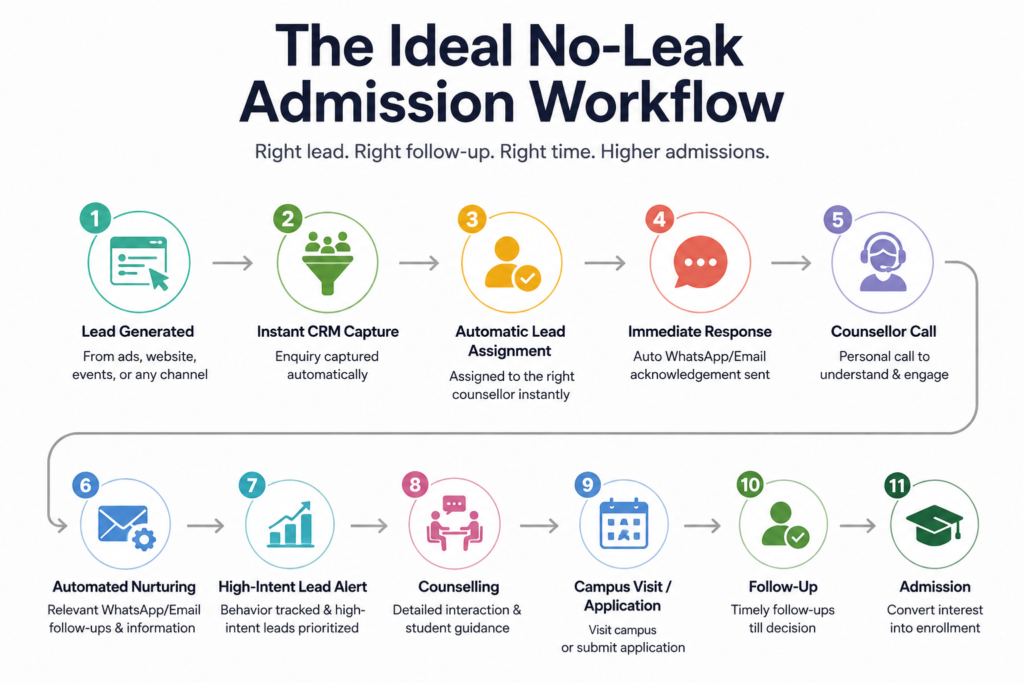
The Ideal No-Leak Admission Workflow
What Should Be Automated—and What Should Stay Human?
Follow the simple rule: automation for consistency; humans for trust.
| Automate | Keep Human |
| Lead capture | Complex questions |
| Acknowledgements | Financial concerns |
| Reminders | Programme selection |
| Routine information | Personal counselling |
| Follow-up prompts | Objection handling |
| Lead assignment | Final admission conversations |
| Segmentation | |
| Basic nurturing |
How to Find the Leak in Your Own Admission Funnel
The number of leads generated is not relevant at this point in the discussion. The conversion at every lead stage is important. The following table shows how to deal with low conversion at every stage.
| Stage | Fix |
| Lead → First Contact | Investigate response time and lead assignment |
| First Contact → Counselling | Review lead quality, counsellor communication and follow-up |
| Counselling → Application | Look at unresolved objections, programme information and nurturing |
| Application → Admission | Examine fees, competition, documentation, follow-up and process friction |
Don’t Pour More Leads Into a Leaking Funnel
It will do you no good to generate additional leads in a funnel that has leakages present. Admissions won’t magically increase by adding in more leads. In fact, it will just increase the leakages, netting off the outcome.
If your college generates 1,000 leads but loses hundreds because of delayed responses, weak nurturing or poor follow-up, generating another 1,000 leads increases the number of opportunities you’re failing to convert.
Final Thoughts
The reason students are dropping out of your college admission funnel isn’t that they are not interested. This leakage is caused by your misunderstanding about how Gen-Z students search for colleges online. Sometimes, all they need is one extra touch or the right follow-up. The goal is to build an admission journey where the right student receives the right information, from the right person, at the right time.